January 1-20, 2020
London
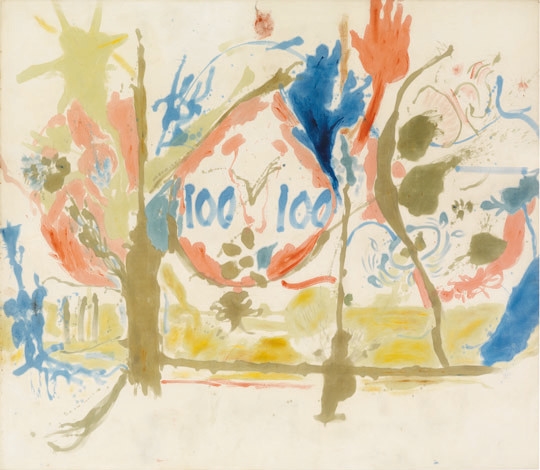
Link : https://www.artsy.net/artwork/helen-frankenthaler-eden
Helen Frankenthaler’s Eden, in the Tate Museum, draws on previous depictions of the Christian Garden of Eden as a tropical garden and then restrains and molds it through the space and limited palette. The entire painting is in lighter shades, all of it almost faded, with the edges empty. The one exception is the dark blue that bursts near the center and towards the edges with the other blue. Most imagery of the Garden of Eden shows flourishing greenery and overwhelming colors. However, Frankenthaler creates the muted colors of the garden through her well known technique of “soak stain” where she diluted the paint with turpentine. It an “interior landscape” from Frankfurter that displays ideas of Eden being the center of life and that the life there is as limited as the color palate she uses (Helen Frankenthaler Explained). Instead of Eden being the main source of energy and movement, the red hand reaching away from the center drags your eyes away from the Garden and towards the empty spaces, the empty spaces where anything could be. Yet the streak that connects the hand to the rest of the painting brings your eyes back down all the way to where it feels still connected to the rooted trees. The browns and yellows builds desert connotations that create a sense of thirst. Since the garden is meant to be a paradise and not a place of want, this builds upon the idea that life in Eden leaves much to be desired.
Helen Frankenthaler Explained, http://everything.explained.today/Helen_Frankenthaler/
“Helen Frankenthaler: Eden (1956).” Artsy, https://www.artsy.net/artwork/helen-frankenthaler-eden.
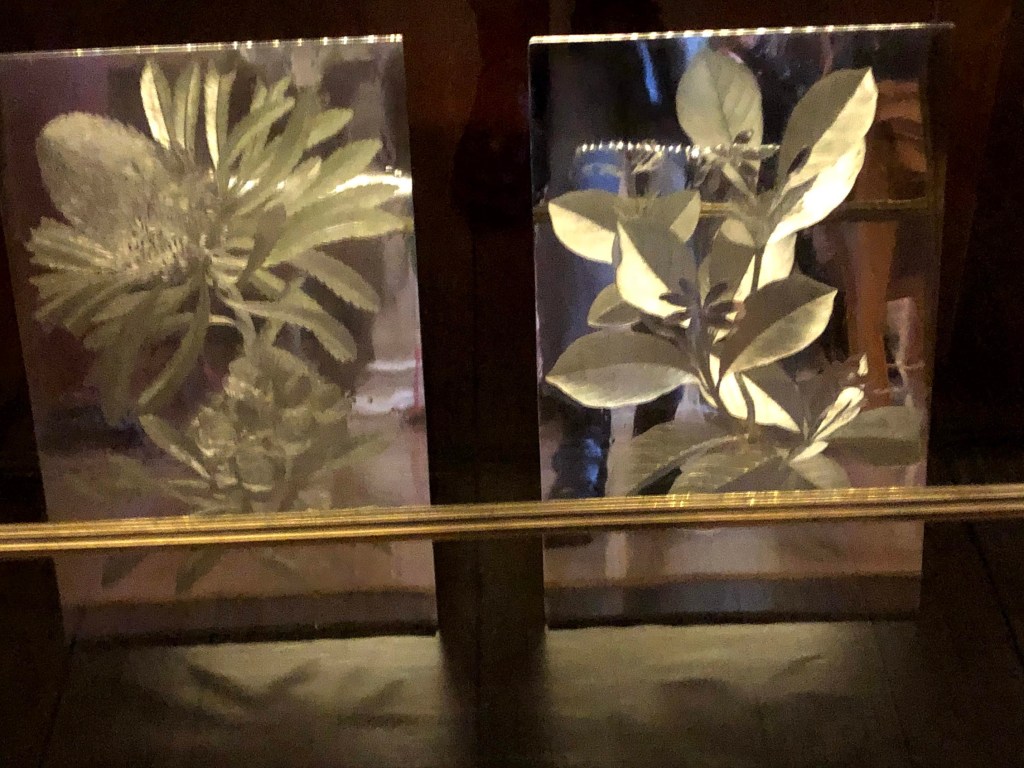
In the British Museum, lent by British History Museum’s Botany Library , there are copper plates of flowers that were made by engravers who were employed by Joseph Banks. Banks had the engravers reference Sydney Parkinson’s drawings and watercolors to make a florilegium after Parkinson passed away. This florilegium was one of the early classification systems for plants, in this specific photo it is a shrub on the left and a flower on the right, eventually called the Banks’ Florilegium. The purpose of the plates such as the ones above, the Banksia serrata and the Gardenia Taitensis, were to spread the information faster and spread knowledge of the discovered or now categorized flowers through books illustrated by on of the eighteen engravers transferred Parkinson’s works to copper plating. Engravers had to accurately reproduce the appearance of the flower in a way that allowed for easy identification in a medium that requires precision and artistry. The plates were never printed in Banks’ lifetime and remain as the product of all of the work that went into increasing the number of known flora in the world by 25 percent (Vaughan). The copper plates may be metal, but they have to be treated carefully and only a limited number of prints are produced before the soft copper disfigures the carvings. Engraving manages to be fragile and lasting at the same time. It may be repeatable but that does not mean that what is produced is any less valuable than a one of a kind.
Yarwood, Vaughan (July–August 2018). “Joseph Banks’ Florilegium”. New Zealand Geographic. 152: 106–107.
Lawson Crescent. “Banks’ Florilegium.” National Museum of Australia, National Museum of Australia; c=AU; o=Commonwealth of Australia; Ou=National Museum of Australia, 26 Oct. 2018, https://www.nma.gov.au/explore/features/european_voyages/european_voyages_to_the_australian_continent/science/banks_florilegium.
Paris
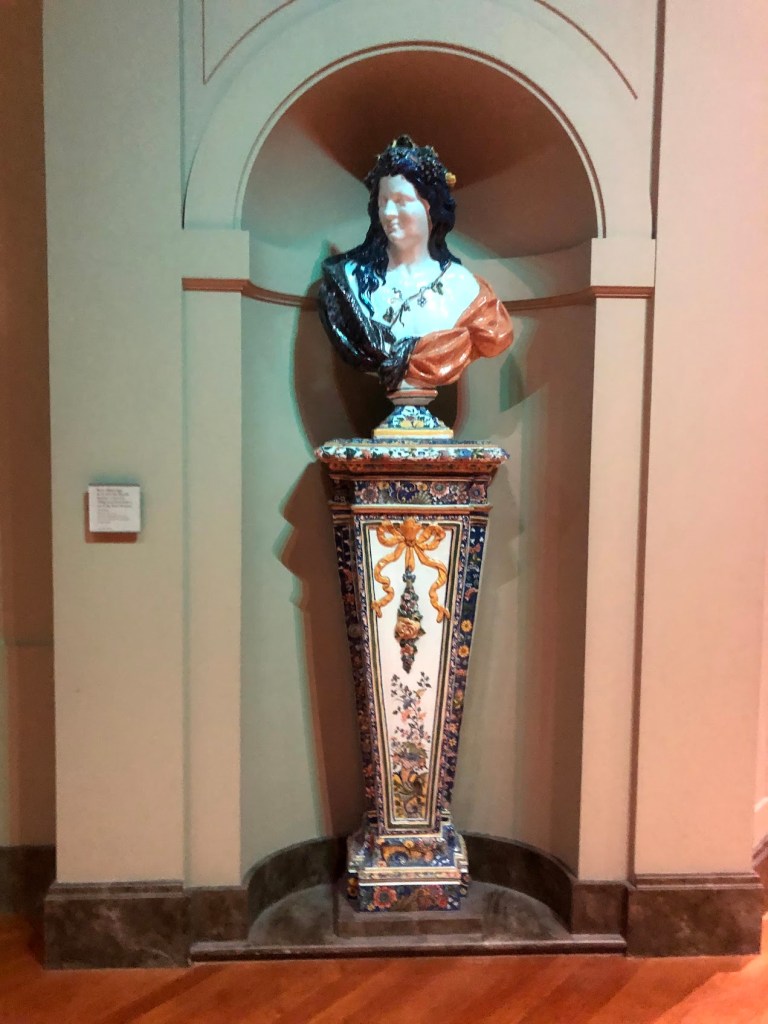
The bust of Autumn was created around 1730, in the factory of Nicolas Fouquay, as part of a set of five busts to represent the four seasons along with the god Apollo (Louvre). This bust is represented by Bacchus, the god of wine. He is covered in the grapes that would be ripening about the time that autumn finally comes to specify this. The fulfillment of a hard harvest and rewards that come with it is shown through the full face and lack of the signs of hunger or dissatisfaction. There is also the deep colors that contrast with the white of the face. Purple is the color of wine and the royalty or wealthy since it was hard to procure which again reminds the viewer of the status of the bust along with the status of the one who owns it. It rests on a pedestal of flowers that bloom in the spring and summer that have just passed, as if autumn is being stacked on top of the past seasons and that winter will be soon to follow. The flowers are also a reminder of the death that comes since autumn is seen as a time for dying. It works with the bone white to build the reminder of eventual death and that it is indisputable. However, the rich colors of the ripe fruit and healthy vines overcome the melancholy and replace it with the reminder of the worth of the temporary pleasures in life, such as wine.
“Work The Four Seasons: Spring in the guise of Flora, Summer as Ceres, Autumn as Bacchus, Winter as an old man,” The Four Seasons: Spring in the guise of Flora, Summer as Ceres, Autumn as Bacchus, Winter as an old man | Louvre Museum | Paris. [Online]. Available: https://www.louvre.fr/en/oeuvre-notices/four-seasons-spring-guise-flora-summer-ceres-autumn-bacchus-winter-old-man. [Accessed: 09-Jan-2020]
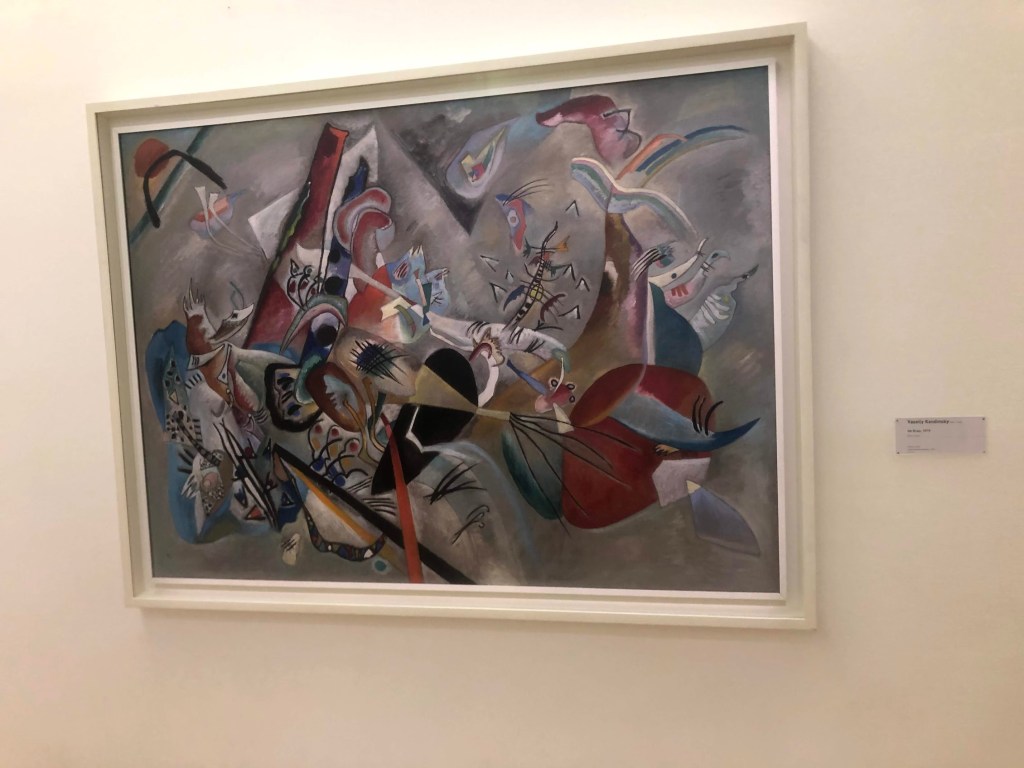
The painting In Grey, 1919 by Wassily Kandinsky within the Centre Pompidou is a combination of soft colors and chaos of the painted shapes that makes sure that the viewer is not too overwhelmed.The influence of post impressionism, fauvism, and cubism is evident through the style that draws on each of them through the (The Art Story). Having the majority of the background being grey, with some attention grabbing colors such as white, black, blue, or red in key areas, means that the solid brushstrokes of the brighter paints come forward towards you. Though the grey is central to the painting, it is not murky and mysterious, the shapes that appear to bear relation to fish or insects are not using the misty background to disappear, but are actually coming out of it. Full of movement that goes from the upper left to the lower right and then swirls as the shapes merge and diverge through conflicting lines and colors, the painting draws attention to the mix of shadows and sharp abstract animals such as the whale and fish giving it an aquatic flow. The shapes with straight paint strokes cause partial stiffness contrasts with the softer colors and curves the branch out from it. The overall effect is of a peaceful, but lively aquarium where you are able to see some fish while other dart in and out of sight. Though there is a lack of blue or green, traditional water colors, which molds an atmosphere of mystery.
“Wassily Kandinsky Paintings, Bio, Ideas.” The Art Story, http://www.theartstory.org/artist/kandinsky-wassily/.
In Grey, 1919 by Wassily Kandinsky, http://www.wassily-kandinsky.org/In-Grey.jsp.
Lucerne
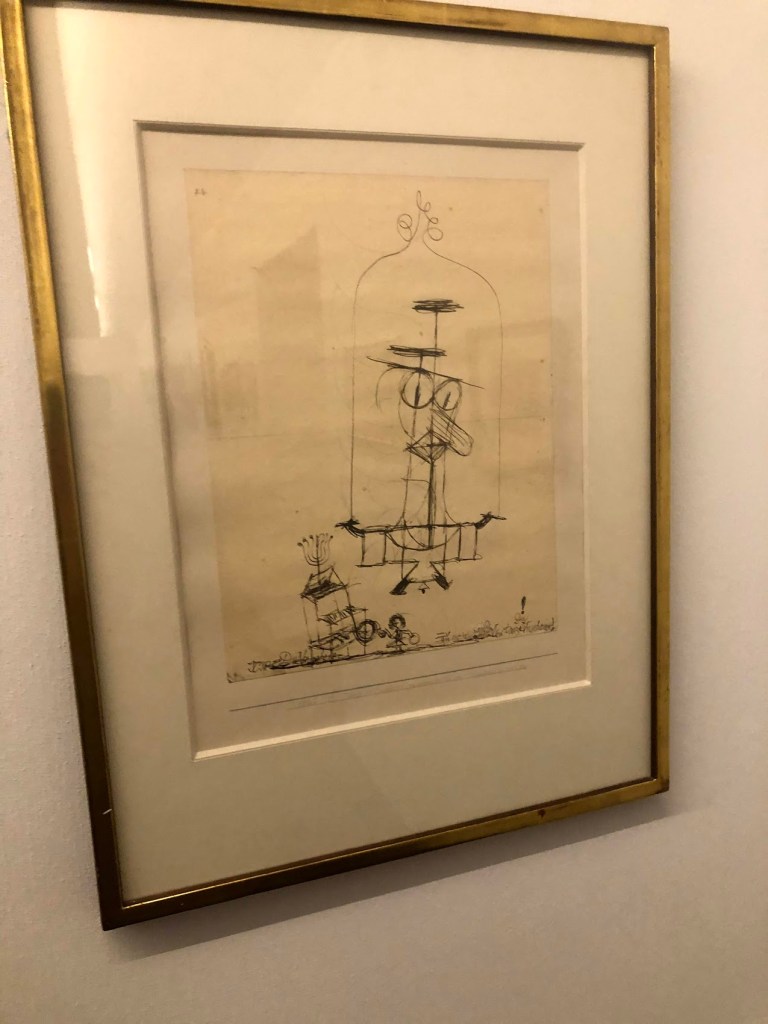
In the Rosengart museum is a sketch for a formal drawing of work that Paul Klee made in a different medium later on. Since it is a sketch, it is in black ink. It was drawn during his time teaching at the Bauhaus in Weimar (Guggenheim). The title of the pen drawing, Dance, you monster, to my gentle song (drawing for 1922/54), confirms what the drawing shows, that it is directed specifically towards a given monster. What that specific monster may be is left up to the interpretation of the viewer. With the song the pianist is about to play described as “gentle”, there is now the idea that they are actively resisting fighting the “monster” in a way that relies on direct violence. Dance, you monster, to my gentle song is also a command that suggests the way to fight is to tame the enemy and deny them a battlefield in the first place. The amount of open space combined with the cramped area of where the piano and pianist are combines with the grand size of the monster to demonstrate that it is not a fair fight. Making the small pianist only the size of the monster’s eyeball only emphasizes this and brings to mind David and Goliath. The pianist is unarmed except for the menorah and piano. The menorah on top of the tiny piano represent the religious and musical influences he had growing up and what they mean to him in the context of the drawing (Jewish Philosophy Place).
“Paul Klee and ‘the Spiritual in Art’ (Dance You Monster to My Soft Song!).” Jewish Philosophy Place, 19 Mar. 2017, jewishphilosophyplace.com/2017/03/19/paul-klee-and-the-spiritual-in-art-dance-you-monster-to-my-soft-song/.
Guggenheim, http://www.guggenheim.org/artwork/artist/paul-klee.
Venice
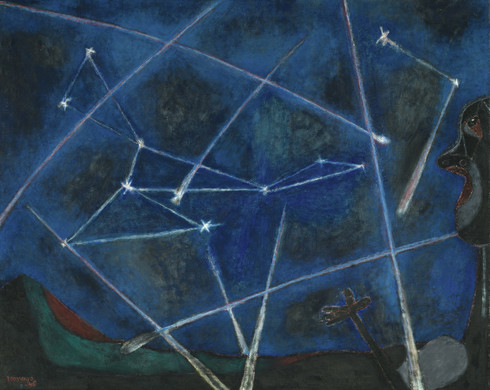
Source : http://www.guggenheim.org/new-york/collections/collection-online/artwork/4029
Rufino Tamayo, born in Oaxaca, Mexico in 1899, painted Heavenly Bodies in 1946, 45 years before his death, with oil paint and sand on canvas. It now resides within the Guggenheim Collection in Venice. The figure appears to be screaming into, or to, the stars. What looks like a hand is reaching up towards the sky as well which emphasizes the loneliness and envy. Tamayo made paintings similar to this one between 1946 and 1947 with primitive people looking to the stars (Flint). This person is reaching towards community and the future. There is also a look of fear that can be attributed to the lack of understanding of what they see. The white stars all have connections illustrated by white lines that are reminiscent of constellations and telegraph or telephone wires while the figure on the ground is completely alone. There is only one line that connects the figure to the sky and it does not go to them, it goes through to the edge of the canvas. It connects the viewer to the stars, but not the person in the painting. Dark blue is the main color of the painting and light is only shown through the stars indicating that life without the stars at all is a life in the dark, literally and emotionally. The simple landscape background shape is similar to the form of the person and that contrasts sharply with the geometrical lines of the sky (Flint). This maintains the separation of the earth and sky.
Flint, Lucy. “Heavenly Bodies.” Guggenheim, 14 Jan. 2020, http://www.guggenheim.org/artwork/4029.
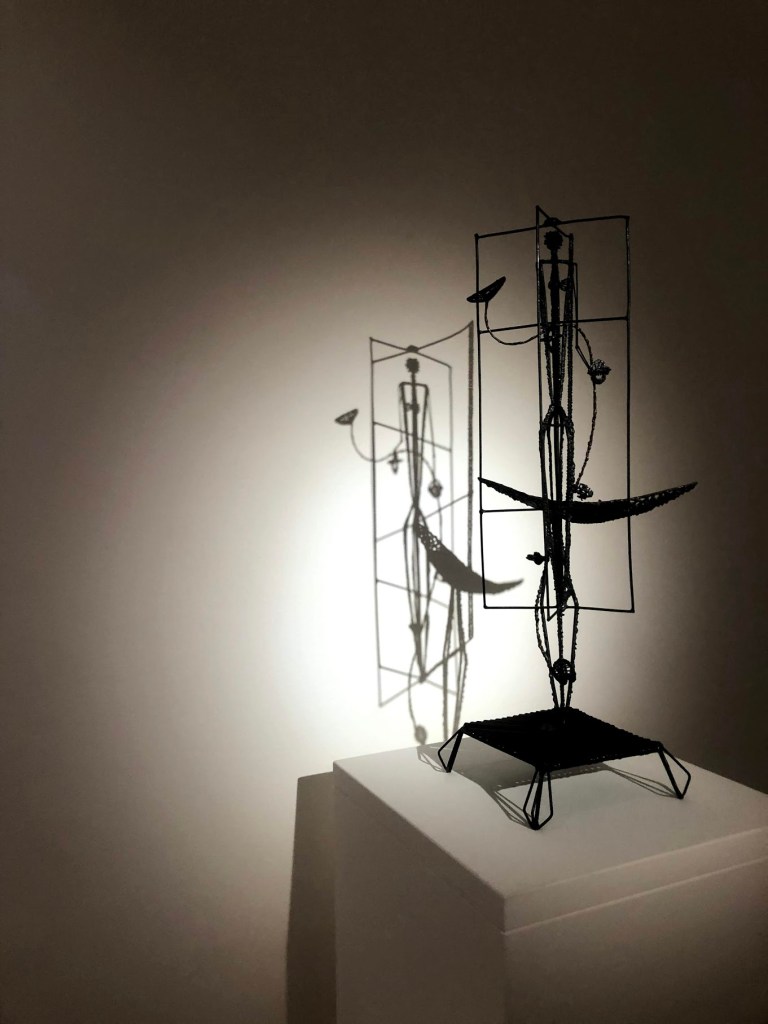
Moon Cage by David Hare is a sculpture made of welded steel in 1951 (David Hare). A sculpture that requires light to fully appreciate the silhouette and how the thin steel outlines conveys an openness while remaining a cage. There is a flow in the winding curves while keeping the characteristic durability of steel emphasized. The crescent shape not only gives the appearance of a crescent moon, but of a boat, which brings a buoyancy from the way it floats above the base of the sculpture. From one angle, the figure is in the middle of the box of wire is a part of the window that appears where the “frames are at once windows that open into space and the bars of a cage that enclose” (David Hare). When you see the difference in the artwork and with its shadow it is apparent that the work relies on being viewed from different angles to convey the varied perspectives it offers. The buds on the winding wire that trails down the sculpture can become a leaves on a vine, flowers on a stem, birds landing on a branch, divets in the surface of what “may be the moon referred to by the title” above a boat, or even stars and planets drifting around the crescent moon (Childs). The lengthy pyramid style shapes lends towards the humanistic figure being perceived as starving in the cage. The base itself is simple and denser than the rest of the sculpture. Held aloft from the pedestal it raises the sculpture even higher.
Childs, Elizabeth C. “Moon Cage.” Guggenheim, 13 Jan. 2020, http://www.guggenheim.org/artwork/4482.
“David Hare.” Guggenheim, http://www.guggenheim-venice.it/inglese/collections/artisti/dettagli/opere_dett.php?id_art=75&id_opera=162.
Florence
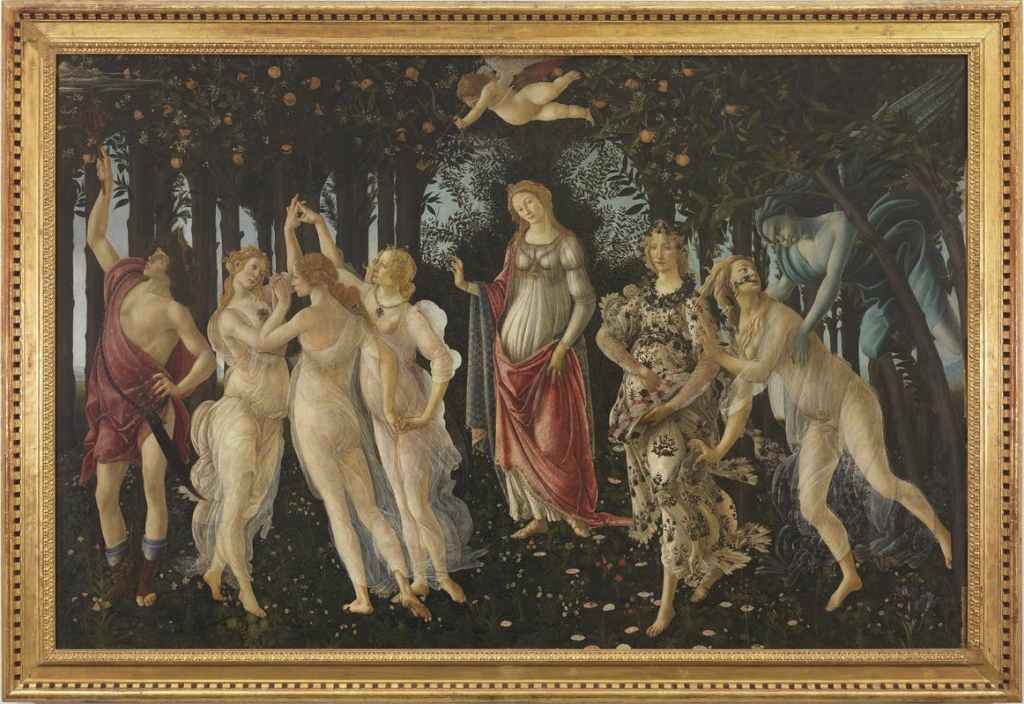
Source : https://www.uffizi.it/en/artworks/botticelli-spring
Spring was painted in 1480 A.D. during the time of the Renaissance by Botticelli and shows off the artistic skills and changes that happened during that time period (Uffizi). The return to classical Greek art subjects include the goddess Flora which relates to Florence, because Florence takes its name from the Latin word meaning flowering since it was founded in the spring. Spring itself is a time of renewal and Botticelli uses that to represent the Renaissance coming after the Dark Ages as spring coming after winter. On the right side is Flora’s transformation that is another representation of the “artistic, humanistic, technological, and scientific flowering” that was happening in Florence during the 1500s (Florence and Central Italy). The title, Spring, itself emphasizes the reference to the Renaissance. The literal meaning of Renaissance is rebirth and spring is the time when that happens. The ripe fruits and flowers indicate the rewards that have come with embracing the “tremendous innovations are made in the fields of mathematics, medicine, engineering, architecture, and the visual arts” (Florence and Central Italy). The inclusion of the three Graces and Mercury, the god of medicine and traveling, again shows the return to the Greek influence and the importance of Florence for its involvement in the life of the Renaissance through supporting the arts and new possibilities in medicine. Florence was a “hub of humanist scholarship and artistic production” during this time and Botticelli is declaring Florence’s greatness (Florence and Central Italy). Found in possession of one of the Medici family, who controlled Italy at that point, would have been a point of pride for showing their influence during such a productive time (Uffizi).
“Florence and Central Italy, 1400–1600 A.D. .” Metmuseum.org, http://www.metmuseum.org/toah/ht/08/eustc.html.
“Spring by Botticelli: Artworks: Uffizi Galleries.” By Botticelli | Artworks | Uffizi Galleries, http://www.uffizi.it/en/artworks/botticelli-spring.
Originally painted for Augustinian monks of San Donato a Scopeto in Florence, Leonardo da Vinci never finished The Adoration of the Magi (The Adoration of the Magi). Being unfinished leaves the remaining sketches draping around the more painted figures as if they were ghosts. Mary and Jesus in particular take on a more spiritual appearance due to the lack of coloring. While that is all completely unintended, the effect of bringing a reminder of the Holy Spirit into the work as a whole through the ghost like sketches remains. Mary and Jesus are centered in the midst of a chaotic background that screams of energy and danger with the horses, the empty desert, and shadows on the bottom edges. Between them and the wild background is a barrier of bewildered believers who seem to be drawn in by the peace they exude. The magi agree with the title of the painting and bow in adoration. The work is oddly not centered on the magi worshipping Christ, it feels more like they point up towards the signs of Christ’s victory through Christianity and his resurrection.The palm tree hanging over Mary and Jesus’ heads is a “representation of martyrdom triumph over death” which references Jesus’ resurrection (The Adoration of the Magi). Painting Jesus as a child contrasts with the idea of death since a baby is closer to birth than death while foreshadowing his victory. The ruins could be a reference to a pagan building being supplanted for Christian use, yet another way to show Christ’s victory.
“The Adoration of the Magi – by Leonardo Da Vinci.” The Adoration of the Magi – by Leonardo Da Vinci, http://www.leonardodavinci.net/the-adoration-of-the-magi.jsp.
Rome
Started in 1536 and finished in 1541, in Michelangelo’s Last Judgement the blue sky separates the groups of people in heaven from the ones going to hell along with Jesus and Mary from everyone, those above hell into sections, and keeps those at the very top apart (Sistine Chapel). This is possibly because Michelangelo worked on the separate frescoes piece by piece or to deliberately show the connections between the groups. Michelangelo’s melted form represents how painting the Sistine Chapel sucked out his creativity and left only his melted remains which is being held by a man looking towards Jesus for approval to take what remains of him up to heaven. He shows the results of giving everything to the church and how even that might not be enough since he is still dripping towards hell. Planned to be as intimidating as possible to drive home Christian values, it was a display to spread the power of the church. The church was the only place to prove that you are worthy of heaven and would be granted permission to get there. Placing it above the altar directly in front of the parishioners where they could stare at it while being lectured about the burning flames of hell and the promised paradise most likely left them feeling indebted to the church for saving them from the demons and torture, adding to the power of the church. The size alone creates an overwhelming sense of doom and hope that is balanced by the open sky behind them all.
“Sistine Chapel.” Sistine Chapel, http://www.museivaticani.va/content/museivaticani/en/collezioni/musei/cappella-sistina.html.
Taking over a hundred years to build, from 1506 to 1615, St. Peter’s Basilica was originally commissioned by Pope Julius II (Britannica). Built in the traditional form of a Latin cross with a large dome, the basilica was handed down and altered per the specifications of the popes until completion(Britannica). Until 1989 it was the largest Christian church (Britannica). This is again to show the power of the Catholics and influence the people through intimidation and faith based awe. The columns on either side surrounding the tourists visiting allude to the Greek influence on architecture that is now dominated by statues of Christian heroes and not those from the pagans. The columned walkways appear to embrace and also to hold captive. To show the wealth of the Catholic church and of the pope, the “interior of St. Peter’s is filled with many masterpieces of Renaissance and Baroque art”(Britannica). While the artists of the Renaissance looked back at the Greek masters of art for inspiration and imitation, the influence of the church ensured that they would not be lacking in powerful propaganda showing their survival and eventual overcoming of the pagan belief system. The statues provide the effect of being watched by the holy and the stairs have you rise to the level of the church, closer to the heaven they preach on. All of this shows how the influence of the magnificent and high profile building was a way for the pope and church gain and protect their power.
The Editors of Encyclopaedia Britannica. “St. Peter’s Basilica.” Encyclopædia Britannica, Encyclopædia Britannica, Inc., 13 Dec. 2017, http://www.britannica.com/topic/Saint-Peters-Basilica.
Follow My Blog
Get new content delivered directly to your inbox.
 European Art and Architecture 2020 January Term Study Abroad